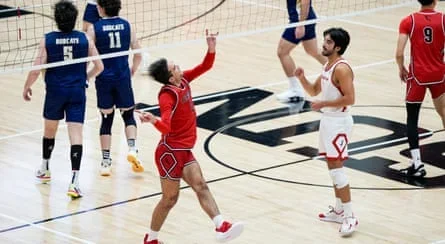
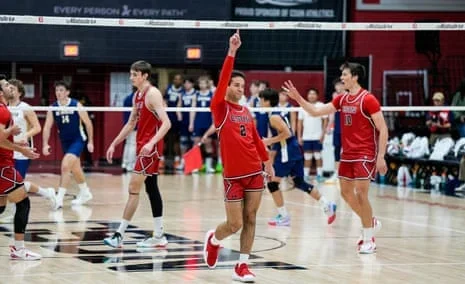
Jordan Lucas: ‘I refuse to tone down who I am. That’s why people tune in to watch me play.’
Photograph: The Big West
The Cal State Northridge standout has garnered millions of views for his hair flips and dismissive gestures. Navigating the attention has become a career in itself.
“I think people are captivated by me because you rarely see someone like me—animated, flamboyant—yet still able to deliver on the volleyball court,” says Jordan Lucas, an outside hitter for the Cal State Northridge men’s team.
Though college volleyball boasts a dedicated fanbase and can draw massive crowds—92,000 spectators witnessed Nebraska take on Omaha in 2023—it typically doesn’t command the same spotlight as basketball or football. That shifted last month when clips of Lucas’s “flamboyant” style—he often celebrates with a hair flick or a dismissive wave toward opponents—went viral, racking up millions of views on social media. College athletes gaining social media fame is nothing new: stars like Paige Bueckers, Harper Murray, Olivia Dunne, and Shedeur Sanders have all had their viral moments. But Lucas’s case is distinct. It’s not just about the highlights; it’s about the conversation surrounding them. Lucas is gay, and that fact has become inseparable from how audiences perceive his game.
Gay male athletes have always existed, but most navigated their careers either by staying in the closet or conforming to a version of masculinity that fit within rigid sports expectations: dominant, stoic, unmistakably “masculine.” Lucas does not. His flamboyance isn’t muted for social acceptance; it’s central to his presence, both on and off the court. While that draws attention, it also invites scrutiny—something he admits has become hard to ignore.
“I feel like people come for the entertainment and the show, and now they’re starting to get invested in my life off the court. It’s taken some getting used to,” he says. The contrast is striking: on the court, Lucas is passionate and expressive; off it, he describes himself as more reserved.
That tension came to a head during a broadcast when UC Irvine announcer Charlie Brande remarked, “I’m amazed Jordan Lucas hasn’t been popped by somebody… The antics he’s making under the net, it’s very distasteful.” Brande later apologized, acknowledging violence should never be “acceptable or tolerated.” It was subsequently confirmed that Brande would no longer call UC Irvine volleyball games.
Lucas’s so-called “antics” are actually celebrations: gestures common across sports, especially in high-pressure moments. Lucas’s difference lies in how he expresses himself—finger snaps, hair flips, waves to opponents, the occasional sashaying turn. In another context, he might be praised rather than dismissed.
“I celebrate because it’s fun. In professional sports—the NBA, NFL, MLB—it’s about talent, but it’s also about what sets you apart,” Lucas says. “I’m not going to tone down who I am. That’s why people watch me play.”
He adds that teammates, coaches, and staff have been overwhelmingly supportive of his self-expression.
Lucas’s path to volleyball wasn’t a given. He grew up in a family of basketball fanatics—his older brother Jarod played for Nevada and Oregon State, and the siblings have supported each other’s careers—but Jordan resisted the sport…