
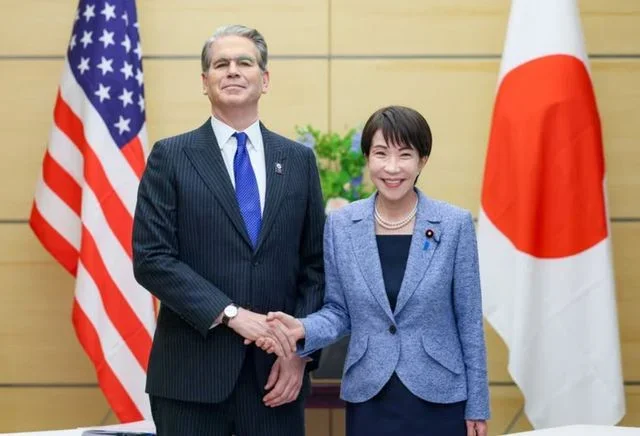
With the Japanese government reportedly preparing to sell off U.S. Treasury bonds, Treasury Secretary Scott Bessent made an urgent trip to Tokyo before his planned visit to China. According to Japanese Finance Minister Sanae Takaichi, the two had a productive discussion, exchanging views on key issues and pledging to elevate the Japan-U.S. alliance to new heights. However, sources revealed that behind the public courtesy call, Bessent privately urged Japan not to complicate U.S.-China relations at a critical moment, specifically warning against any sale of U.S. bonds that could harm America’s fiscal position and dollar dominance.

A telling detail emerged from Takaichi’s remarks: she noted this was Bessent’s 56th visit to Japan—not five or six, but 56. Such frequent trips stem from Bessent’s deep ties to Wall Street and Japan. In 1991, he joined Soros Fund Management, making his mark during the 1992 shorting of the British pound and the 1997 Asian financial crisis. By 2011, he became chief investment officer of the Soros family fund, orchestrating a massive short on the yen during Shinzo Abe’s tenure that netted $1 billion in one year. Dubbed the “yen killer,” Bessent later founded his own firm with $2 billion from Soros, and in 2022 he made another bold bet on the Bank of Japan’s rate hike, pocketing $1.5 billion and earning the title of “Global Macro Fund Manager of the Year.” Those experiences gave him unparalleled insight into Japan’s economy, along with extensive connections in Japanese political and academic circles.
Japan’s economy is now on the brink, with Takaichi repeatedly intervening in currency markets. Bessent knows exactly how this scenario might unfold. Back at the Davos economic forum in January, he had already warned Japanese Finance Minister Kazuyuki Katayama, demanding Tokyo adopt “responsible and sustainable” fiscal policies. Insiders described Bessent’s tone as nearly scolding, so rapid that Japanese officials struggled to keep notes. His message: Japan must fulfill its investment commitments to the U.S. and refrain from selling U.S. bonds. As for where Japan would find money or how to weather its economic troubles, that was not Washington’s concern. At the time, Tokyo cooperated, but since the outbreak of the U.S.-Israel-Iran war and the closure of the Strait of Hormuz in March, Japan’s economy has been pushed to the edge.
One telling sign: Japanese snack giant Calbee announced it would change packaging of some flagship products from color to black-and-white due to supply chain disruptions from the Middle East crisis. If even a national consumer brand faces such measures, other industries are under immense pressure. Since late April, the yen has plunged so sharply that Takaichi ordered currency intervention out of desperation. But from Bessent’s perspective, any sell-off of U.S. bonds is unacceptable. Bessent reportedly told Takaichi that short-term intervention is not a cure; the Bank of Japan